



- May 20, 2026
Improving Drought Resilience
Across much of the United States, farmers and ranchers are facing increasingly dry conditions, unpredictable rainfall, and rising input costs. As drought-prone seasons become more common, many producers are looking for practical ways to improve drought resilience without relying solely on expensive inputs or short-term fixes.
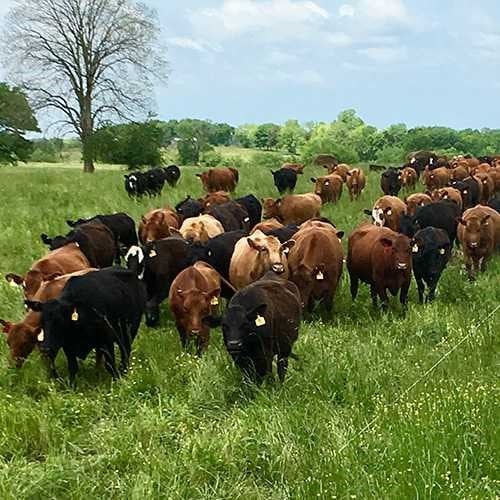
One of the most effective long-term strategies is healthy grazing management. Adaptive and regenerative grazing practices can help improve soil water retention, support stronger forage growth, and build more resilient farming and food systems over time.
If you’re interested in learning how to do this in a hands-on, in-person setting, Check out our upcoming academy that’s focused solely on adaptive grazing for resilient farms and landscapes.
Healthy grazing is not just about moving livestock from one pasture to another. It is about managing land in a way that supports healthier soil, stronger root systems, and improved water holding capacity during both wet and dry seasons. (A Hedge against Drought: Why Healthy Soil is ‘Water in the Bank’)
How to Improve Soil Water Holding Capacity
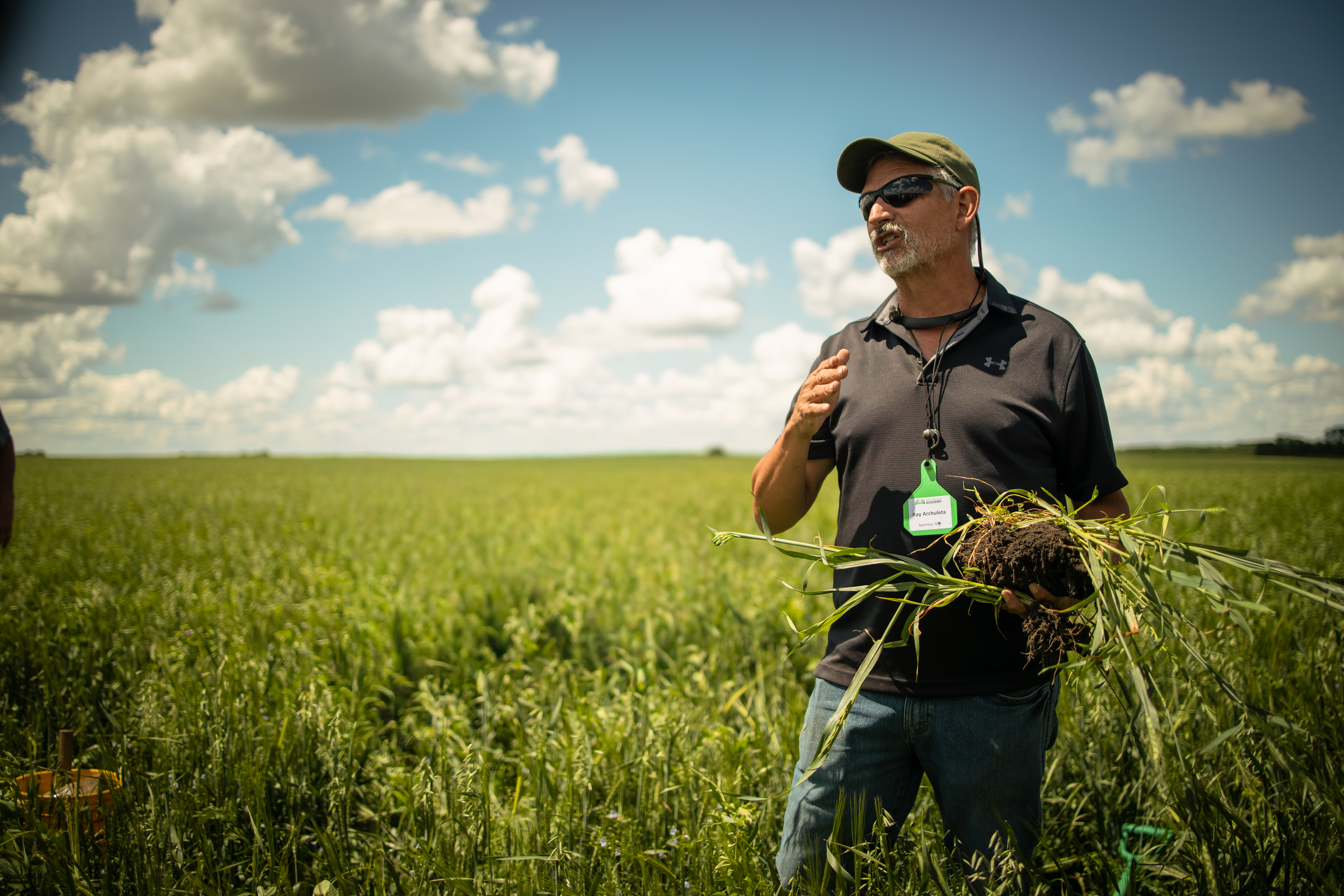
When rainfall becomes limited, the condition of the soil plays a major role in how well a farm or ranch can withstand dry periods. Healthy soil acts like a sponge, helping absorb rainfall, reduce runoff, and store available water for plants over time.
Unfortunately, overgrazed or degraded land often struggles to retain moisture. Bare ground heats up quickly, water runs off instead of soaking in, and shallow-rooted plants become stressed much faster during drought conditions.
Improving drought resiliency often starts by improving the relationship between soil, plants, livestock, and water cycles.
– Producers focused on resilience farming practices frequently work toward:
– Increasing soil organic matter
– Maintaining living roots in the soil
– Improving field water capacity, so it holds onto water better
– Supporting diverse forage species
– Reducing bare ground exposure
– Preventing soil compaction
These practices help create soil with water holding capabilities that support forage growth even during dry conditions.
How Healthy Grazing Practices Improve Soil Water Retention
Healthy grazing management, such as adaptive grazing, allows pastures to recover properly between grazing periods. When plants have enough recovery time, they develop deeper root systems that can access moisture farther below the soil surface.
Deeper roots also help improve soil structure over time, increasing the soil’s ability to absorb and retain water.

This is one reason adaptive grazing systems are becoming more popular among producers interested in climate resistant farming and long-term land productivity. ()
Healthy pasture management practices can help:
– Improve soil water retention
– Increase water infiltration
– Reduce erosion during heavy rainfall
– Support drought tolerant forage growth
– Improve water holding capacity of soil
– Increase available water for plants during dry periods
In many cases, producers discover that healthier grazing management reduces the need for supplemental feed as well because pastures remain productive longer into dry seasons.
How to Prevent Overgrazing During Drought Conditions
One of the biggest challenges during dry years is avoiding overgrazing. When plants are repeatedly grazed before fully recovering, root systems weaken and soil becomes more vulnerable to drought stress.
Learning how to prevent overgrazing is one of the most important parts of a drought resilience plan.
Some key strategies include:
– Allowing adequate pasture recovery time
– Adjusting stocking density based on rainfall conditions
– Monitoring forage height and root recovery
– Rotating livestock according to plant health rather than rigid schedules
– Keeping adequate residue and ground cover on the soil surface

Adaptive grazing differs from conventional systems because it allows producers to make decisions based on current land conditions rather than fixed timelines. This flexibility can be especially valuable during unpredictable weather patterns.
Building a more drought resistant landscape
Healthy grazing practices do more than support livestock production. They also help create a more drought resistant landscape over time.
As soil biology improves and plant diversity increases, pastures often become better equipped to capture and hold rainfall. More water infiltrates into the soil instead of running off the surface, helping improve long-term water holding capacity.(Adaptive multi-paddock grazing improves water infiltration in Canadian grassland soils)
Over time, many producers notice:
– Improved pasture recovery
– Better forage diversity
– Reduced runoff
– Increased drought tolerance
– More stable production during dry periods
These outcomes are becoming increasingly important as producers look for practical solutions that support both profitability and environmental resilience.
Adaptive Grazing and Resilient farming systems
Adaptive grazing is not a one-size-fits-all system. Every farm, ranch, climate, and landscape is different. However, the goal remains the same: work with natural systems instead of against them.
By focusing on soil health, plant recovery, and water cycles, producers can begin building resilient farming and food systems that are better prepared for future drought conditions.
Many farmers and ranchers are now exploring how to increase soil water holding capacity naturally through grazing management rather than relying entirely on synthetic inputs or intensive mechanical practices.
The result is often healthier land, stronger forage production, and improved drought resilience year after year.

Learn More about adaptive grazing systems
For producers interested in learning more about adaptive grazing, soil health, and practical drought resiliency strategies, Soil Health Academy offers educational resources and hands-on learning opportunities focused on regenerative agriculture and healthy land management. Our upcoming event is all centered around adaptive grazing systems, designed to help farmers, ranchers, and land managers better understand how adaptive grazing systems can improve pasture management, support soil health, and strengthen drought resilience for the future. Learn more about this event and register below!
Adaptive Grazing for Resilient Farms & Landscapes

Sources:
Derner, Justin D and Augustine, David, J. “Adaptive Management for Drought on Rangelands.” Rangelands, Volume 38, Issue 4, 2016, Pages 211-215, Science Direct, https://www.sciencedirect.com/science/article/pii/S0190052816300293.
DeLonge, Marcia and Basche, Andrea. “Managing Grazing Lands to Improve Soils and Promote Climate Change Adaptation and Mitigation: A Global Synthesis.” Renewable Agriculture and Food Systems, Cambridge University Press, https://www.cambridge.org/core/journals/renewable-agriculture-and-food-systems/article/managing-grazing-lands-to-improve-soils-and-promote-climate-change-adaptation-and-mitigation-a-global-synthesis/74079A2F7E88CA75FF99E4E096BC32E4.
Nichols, Ron. “A Hedge against Drought: Why Healthy Soil Is ‘Water in the Bank.’” United States Department of Agriculture, 12 May 2015, https://www.usda.gov/media/blog/2015/05/12/hedge-against-drought-why-healthy-soil-water-bank.
Timm F. Döbert, et. al. “Adaptive Multi-Paddock Grazing Improves Water Infiltration in Grassland Soils.” Geoderma, vol. 401, 2021, Science Direct, https://www.sciencedirect.com/science/article/abs/pii/S0016706121003943.