



You Can’t Make It Rain. Here’s How to Keep More of It.
You cannot make it rain. You can decide how much of it you keep.
We say that at our academies, usually standing in somebody’s field with a shovel. It tends to land harder in a year like this one. So before the ground freezes, we want to walk through what it means, what it is worth in water, nitrogen and dollars, and what you can still do about it this fall.
The spring that proved it
This past April, eight western states set record-low snowpack for April 1: Arizona, Colorado, Idaho, Nevada, New Mexico, Oregon, Utah and Wyoming. California came in second-lowest in its history at 20 percent of median. A March heat wave melted what little had fallen, and some basins hit their earliest meltout since records began. (Western snow drought conditions, April 2026)
By early May, about 60 percent of the lower 48 was in some stage of drought. Ninety-eight percent of the cotton crop sat in drought territory, along with roughly a quarter of corn and soybean acres. (Drought coverage, May 2026 and crop acres in drought, late May)
None of that was a management decision. Nobody reading this chose the snowpack or the heat. But what happened on your ground when the rain finally came was a management decision, whether you made it on purpose or not.
Same storm, two outcomes
Picture one inch of rain landing on two fields across the road from each other.
The first field was tilled this fall and left bare. The surface has crusted. There is nothing standing on it and nothing living under it. The first few minutes of rain seal the top, and everything after that runs. Water leaves the field, and it takes the finest, most fertile soil particles with it. That inch mostly ends up in the ditch, and some of the field goes with it.
The second field has residue on the surface and roots in the ground. The soil underneath is aggregated, which is a plain way of saying it is built like a sponge instead of a brick. Raindrops hit cover before they hit dirt, so the surface never seals. Water moves down through pore space the roots and biology have been building for years, and it stays there, where next season’s crop can reach it.

Same storm. Same inch. One field is wetter and one field is smaller.
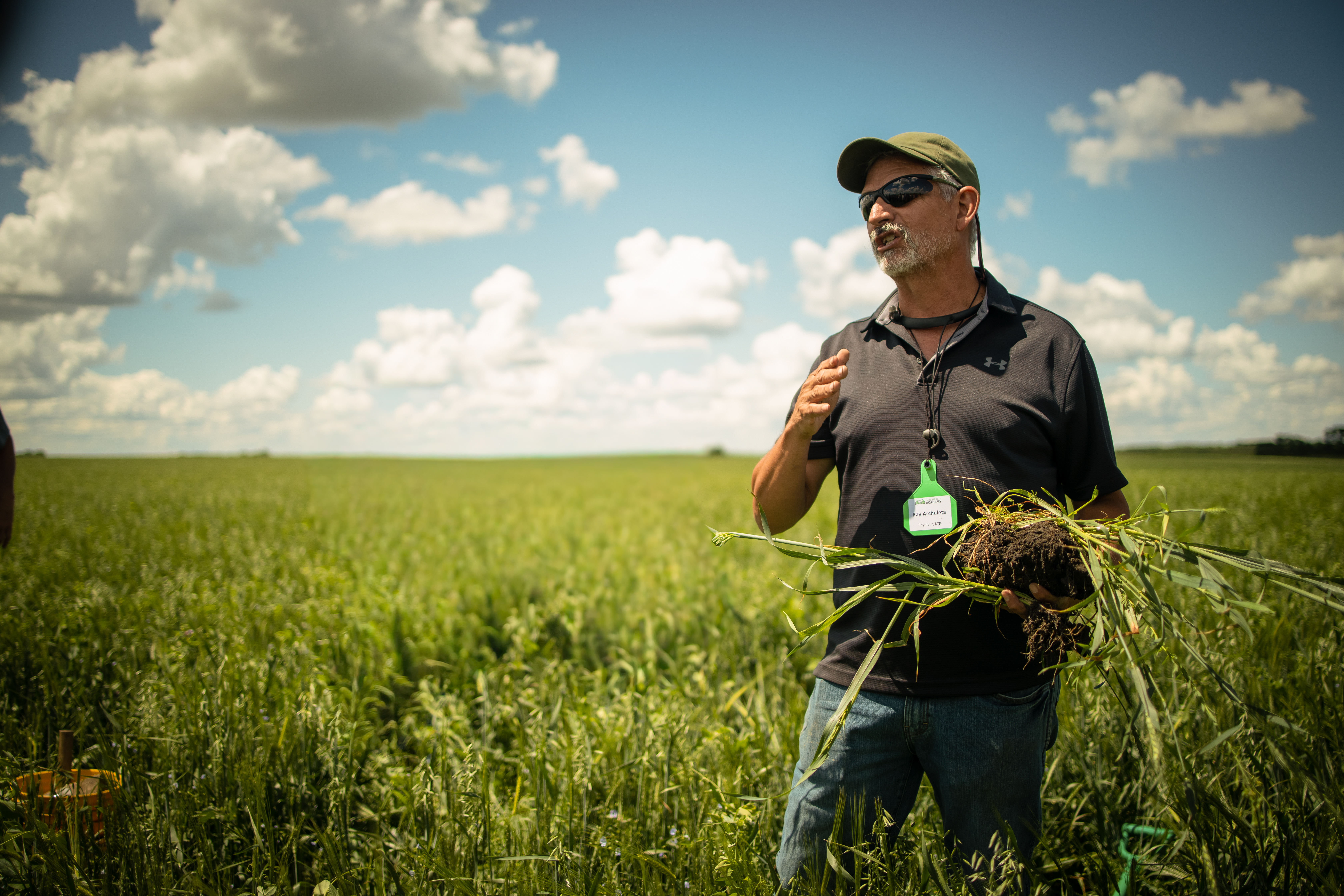
This is the heart of what we teach, and it is why we spend so much time on infiltration at our academies. Rainfall is a weather report. Infiltration is a management outcome. You control the second one with four decisions: how much you disturb the soil, how much of it you keep covered, how many months of the year something is growing in it, and how many different things are growing there.
Why infiltration matters more in a dry year
In a wet year, poor infiltration shows up as ponding and erosion, and it is easy to shrug off. In a dry year, every inch you shed is an inch you paid for and did not get to use. There is no spare water to lose. That is why we tell producers that infiltration is not a soft benefit. In a drought it is the whole ballgame.
What a percent of organic matter is actually worth
The sponge in that second field is mostly soil organic matter and the biology that builds it. When producers ask us whether organic matter is worth chasing, we answer in three currencies: water, nitrogen and dollars.
Water. Each additional percent of soil organic matter lets your soil hold roughly another inch of moisture. In a year when your total rainfall is short, that inch is the difference between a crop that finishes and one that does not. (Organic matter and water storage, NDSU long-term study)
Nitrogen. That same percent of organic matter holds 20 to 40 pounds of nitrogen per acre, released slowly through the season as biology does its work. It adds up. Soils in continuous no-till for six years or longer have been shown to need 40 to 50 pounds less nitrogen per acre to grow the same corn crop. (NDSU corn fertility recommendations) Before you price fall nitrogen, it is worth knowing what your ground is already supplying.
Dollars. We hear a version of the same question at every academy: does this pencil? The producers who have run soil health systems long enough to answer say yes. When 100 farmers across nine states and 194,003 acres opened their books, net income was up an average of $51.60 an acre on corn and $44.89 on soybeans. It rose for 85 percent of the corn growers and 88 percent of the soybean growers. Corn cost about $24 an acre less to grow. Ninety-seven percent of them said their crops handled extreme weather better. (Economics of soil health systems on 100 farms) A follow-up on 29 farms in 20 states, growing everything from cotton to walnuts, put the average gain at $65 an acre. (Nationwide 30-farm study, 2023)
Two things we would add from the field. Those farmers had years in the system, roughly 19 years of no-till and nine of cover crops on average, so that is a mature number, not a first-season number. And the costs were real: about $48 an acre on corn against $99.60 in benefits. Nobody is promising free money. We are saying the ledger favors the sponge.
Slow to build, fast to spend
Here is the part that keeps us honest. Organic matter is a savings account that fills slowly.
One of the longest-running cropping trials in the northern Plains started in 1987 on ground testing 3.2 percent organic matter. Thirty-five years later, after dropping fallow from the rotation, adding high-residue crops, cutting tillage and applying composted manure, the best system in the trial had reached 4.3 percent. That is 1.1 points in 35 years. The average across all the systems was closer to half a point. (NDSU long-term cropping systems study)
That is what building looks like: decades of stacked decisions, each one small.
Spending it is a lot faster. Every tillage pass puts oxygen into the soil and burns organic matter the biology took years to build. We have never met a farmer who tilled on purpose to lose organic matter. It happens as a side effect of other decisions, one pass at a time, and the ground does not send a bill until the dry year shows up.
So the question we ask producers is not whether to build organic matter. It is whether to stop drawing it down. That is the cheaper half of the equation, and it starts this fall.
What to do before the ground freezes
You cannot rebuild organic matter between now and Thanksgiving. You can make sure next spring’s rain has somewhere to go. Four things we would do on our own ground this month, in order of how much they cost:
Skip the fall tillage pass. If the only reason for it is habit or how the field looks from the road, leave it. Standing residue is armor against both rain and wind, and you keep the organic matter that pass would have burned.
Leave the residue where it fell. Chopped and spread beats baled and hauled. If you need the feed, graze it rather than removing it, and let the animals do the spreading.
Get something living in the ground if there is still a window. A late cereal rye seeding will not look like much this fall, but roots working through winter are what turn next April’s rain into stored water instead of runoff.
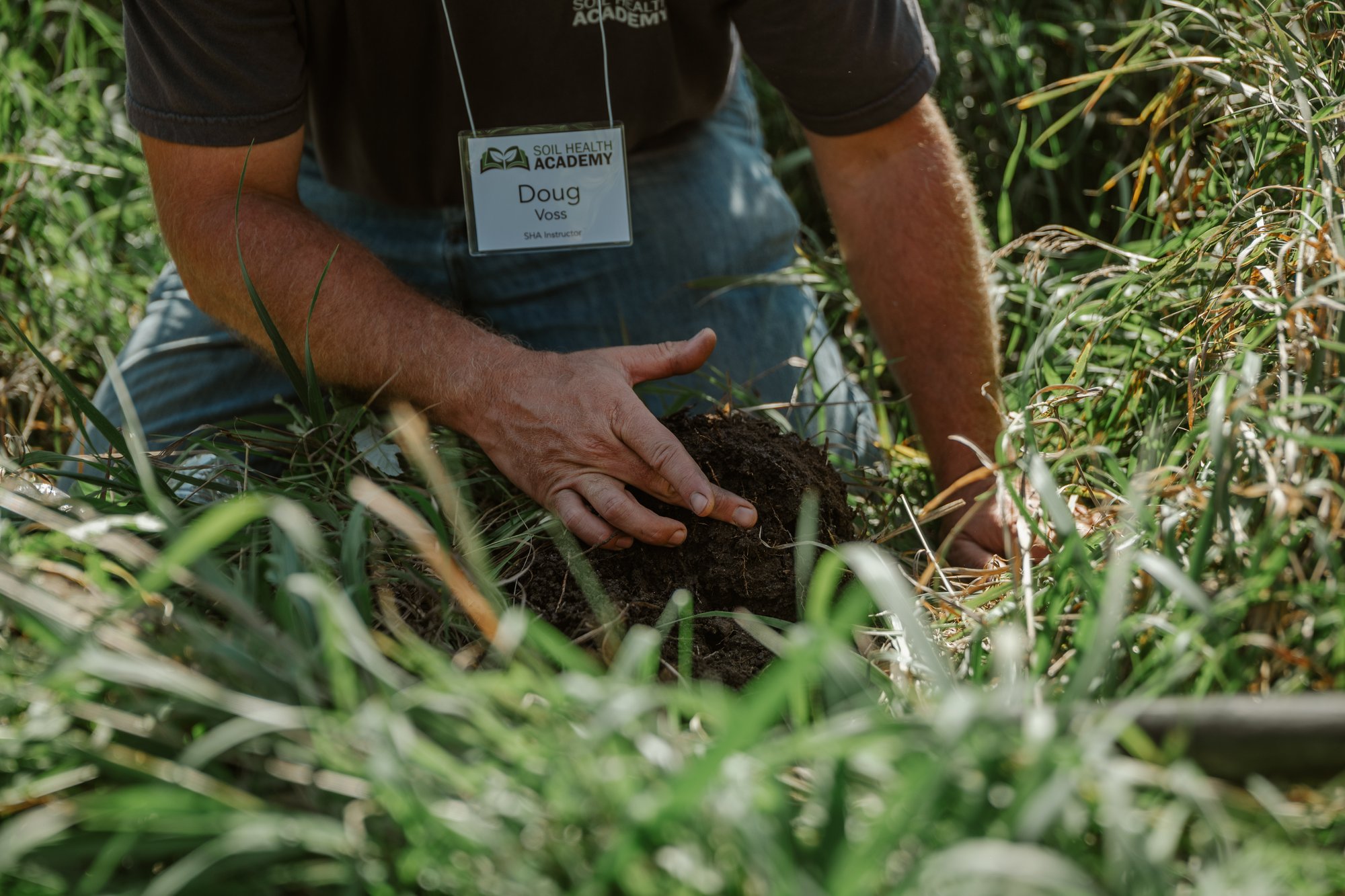
Dig a hole. This one is free. Take a shovel out to two spots: one you have been easy on and one you have worked hard. Look at the structure. Smell it. Watch how it breaks apart in your hands. If you want a number, push a ring into the soil, pour in an inch of water and time it. The ground will tell you more than any lab report about what it is going to do with the next storm.
If you have attended one of our academies, you have done that last one with us, and you know the look on people’s faces when the two holes come out different. That difference is the whole lesson.
Decide what you keep

The weather in 2026 made the case for us. Record-low snowpack, a hot March and drought across most of the country, and none of it was anything a producer could manage. What a producer can manage is the sponge: less disturbance, more cover, living roots for more of the year and more diversity in what grows. Those four decisions decide how much of every storm you keep, how much nitrogen you buy and whether your operation is still standing after the next dry year.
At Soil Health Academy, we teach this in the field, on working farms, with the people who made these decisions on their own land and can show you what came of them. If this piece raised a question about your own ground, we want to hear it. Reply to our monthly newsletter, send it to us at info@soilhealthacademy.org, or bring it to the next academy. We will have a shovel waiting.